
Most capable AI models still live in a data centre. You send a prompt, you wait for a server, and your code leaves your machine. Thinking Machines Lab released Inkling 2 Mini on 20 November 2026 to change that trade off for one job. It is a small open weights model built to run on a laptop. It is aimed squarely at agentic coding. That claim is easy to make and hard to prove. A small model can still be useless on real work. It must read a repository, call tools, edit files, run tests, and recover from mistakes. Inkling 2 Mini is interesting because its first results say it does that work better than other open weights models of a similar size. It does the work in an unusual way. It reuses part of itself three times for every token.
What Inkling 2 Mini is
Inkling 2 Mini is a general purpose multimodal model. The model accepts text and image inputs. It produces text outputs. Inkling 2 Mini is intended for English and other languages, and for multiple coding languages. Thinking Machines Lab says developers can use it for agentic systems, coding assistants, chatbots, retrieval augmented generation, and general conversation. The release matters for three reasons. First, the weights are open. Second, the model is small enough for local hardware. Third, the licence is Apache 2.0. A developer can download it, run it locally, fine tune it, and integrate it into a product, subject to the licence and the acceptable use policy.
It has 26.4 billion total parameters. It has 3.4 billion active parameters per token. After looping, Thinking Machines Lab reports 5.4 billion weight activations per token. Artificial Analysis reports the same 5.4 billion figure. It says the model uses 3.1 billion unique weights per text token. The difference is counting, not contradiction. The 3.4 billion figure counts active weights on a single pass. The 5.4 billion figure counts the repeated work from looping.
How looping works
Inkling 2 Mini is a looped transformer. It runs its middle layers three times for every token. A normal model passes each token through its layers once. Inkling 2 Mini has 24 layers, in four blocks of six. First, the first block runs once. Next, the two middle blocks run three times. Finally, the last block runs once. The arithmetic is exact. Six, plus 12 run three times, plus six, gives 48 layer applications per token from 24 stored layers. Only the middle 12 layers are repeated. That is why multiplying 3.4 billion by three would give the wrong estimate.
So, why loop the middle? Thinking Machines Lab says the middle layers carry more abstract reasoning. The first and last layers devote more space to translating between embeddings and internal representations. In its experiments, looping the middle 12 layers beat looping the last 12 layers on 27 out of 28 evaluations. The model also uses attention residuals. Each layer reads earlier block outputs and learns its own mix. Every pass starts with the first block output, called the prelude. The second and third passes also read the previous pass output, called the message. A learned gate merges that message.
What Inkling 2 Mini runs on
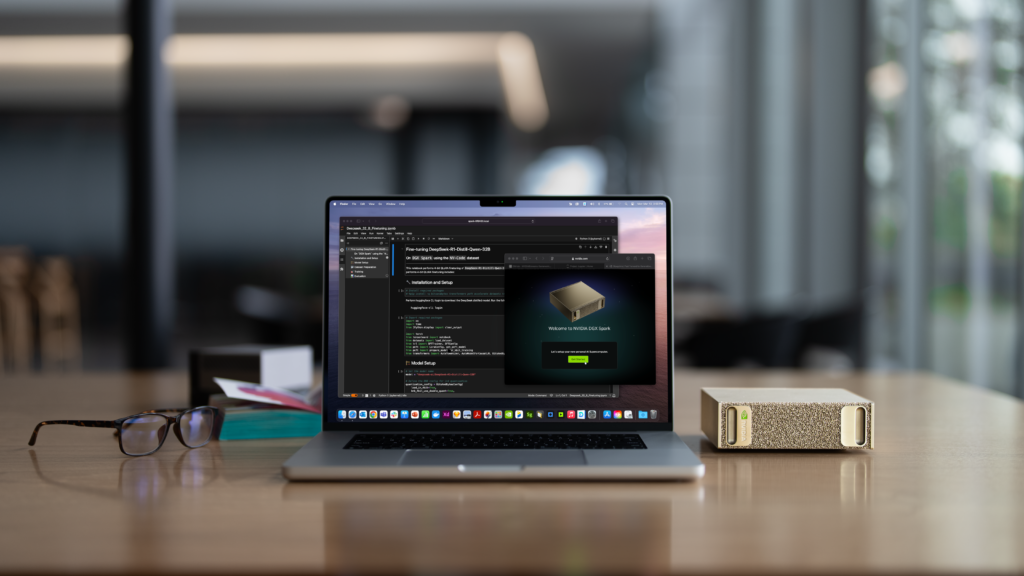
A 20GB checkpoint is small, but it is not the whole story. You still need memory for the runtime, the context, and the agent tools. Thinking Machines Lab supports Inkling 2 Mini on any Mac system, including MacBook and Mac Mini, with at least 32GB of RAM through Ollama. The model card lists the same floor for Apple silicon devices, including MacBooks, Mac minis, and Studios. It also lists one NVIDIA DGX Spark, and other GPUs with 32GB or more of video memory recommended.
As a result, that 32GB floor is the number to plan around. A 20GB model on a 16GB laptop will not leave enough room for a long context and a working agent. The lab demonstrated the point on a flight. Its researchers ran Inkling 2 Mini offline on a MacBook Pro with an M5 Pro chip and 48GB of memory. It built a playable flight simulator in a few minutes.
What Inkling 2 Mini does well
Thinking Machines Lab says Inkling 2 Mini does best on long horizon agentic work. It says it is the best among open weights models of similar size on most tasks it measured. On DeepSWE version 1.1, it scores 48.2 percent. The lab says that leads every open weights model with less than 100 billion total parameters on that test. Its Vals Index version 2.2 score is 46.5 percent, with the same claim. On the Artificial Analysis Index version 5.0, it scores 20.1. That ties Qwen3.8 27B.
In addition, on SWE Bench Pro version 2 Hard, it scores 77.9 percent, against 73.8 percent for Qwen3.8 27B. For SWE Bench Verified, it scores 79.2 percent, against 77.8 percent. On SWE Bench Multilingual, it scores 73.7 percent, against 70.0 percent. On Vibe Code Bench version 1.1, it scores 77.9 percent, against 64.9 percent. That is the largest coding lead in the table. On FrontierCode version 2.0, it scores 15.1 percent, against 14.9 percent, a practical tie. On Terminal Bench version 4.0, both score 5.6 percent.
What Artificial Analysis adds
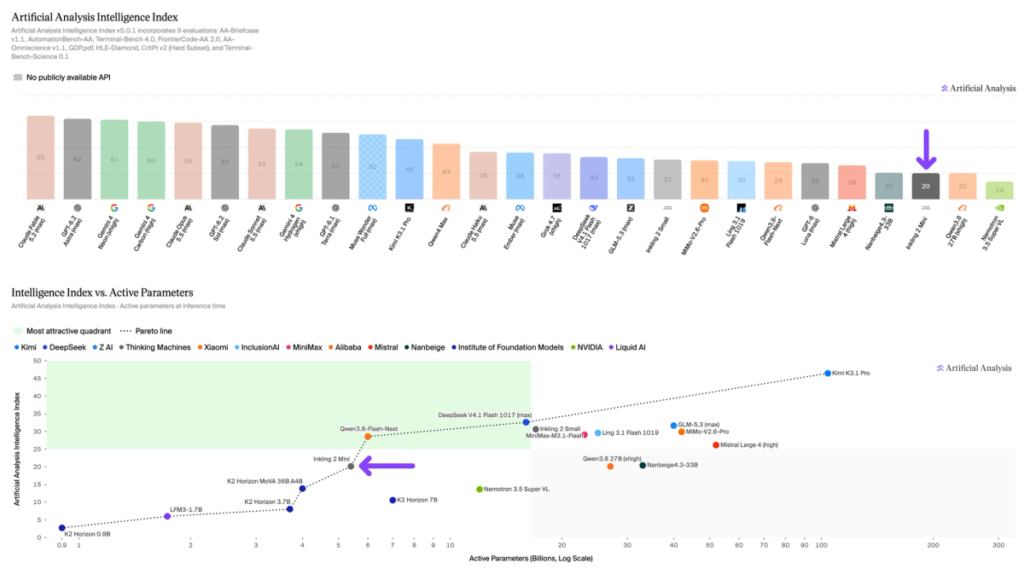
Artificial Analysis provides the most useful independent check. It places Inkling 2 Mini at 20 on its Intelligence Index. That is the same score as Qwen3.8 27B on the high setting and Nanbeige 4.3 33B. The point is the cost of reaching that score. Inkling 2 Mini matches those models with about five times fewer active parameters than Qwen3.8 27B, and about six times fewer than Nanbeige 4.3 33B. Artificial Analysis says it sits on the Pareto frontier for intelligence versus size.
However, Inkling 2 Mini uses about 38 percent more output tokens than Qwen3.8 27B for the same score, but about 2.8 times less compute. The model averages about 152,000 output tokens per task, against about 110,000 for Qwen3.8 27B. For each Intelligence Index task, it costs 0.59 dollars and takes 9.0 minutes, against 3.53 dollars and 38.2 minutes for Qwen3.8 27B. Artificial Analysis calls that about six times cheaper and about four times faster per task.
Where Inkling 2 Mini falls short
Thinking Machines Lab is unusually direct about the limits. The model is not the strongest small model for multi turn chat, or for instructions with many constraints. It scores 50.0 percent on MultiChallenge and 33.4 percent on ComplexConstraints version 1.1, behind Qwen3.8 27B on both. It also trails larger models on reasoning intensive tests such as CritPt version 2 and HLE Diamond.
However, the knowledge limit is structural. Looping improves reasoning, but it does not let the weights store more facts. Knowledge is mostly a function of total parameter count. Inkling 2 Mini scores on AA Omniscience, a measure of factuality, are in line with other models of the same size. The lab says the model overcomes that gap by using search and tools efficiently. That is why its BrowseComp, DeepSearchQA, and MCP Atlas scores are strong. Give it tools and search, and it can punch above its size. Ask it to recall obscure facts from memory alone, and it will behave like a small model, because it is a small model.
Looping and monitorability
One reason the lab released Inkling 2 Mini is to let researchers study looped transformers. A key tool for understanding an AI system is monitoring its chain of thought, the reasoning a model writes out as it works. In a normal transformer, each token passes through a fixed stack once. That limits the sequential steps a model can perform before it must output a token, so reasoning that needs more steps has to appear in generated text, where it can be read. Looping raises that limit. A looped model does more computation per token internally before verbalising its thought process. Reasoning that never appears in the chain of thought cannot be caught by a chain of thought monitor. That has led to concerns that looped transformers could be harder to oversee.
However, early findings are reassuring, with limits. The no chain of thought horizon rises from 16 seconds at one pass to 37 seconds at three passes. Reasoning grew shorter with more loops but stayed legible. Controllability remains poor, at most 0.1 percent. In LinuxArena tests, researchers saw no clear trend with the number of looped passes. Keep the usual safeguards in place.
How to try Inkling 2 Mini, and who should wait
Start with the hosted option if you want to test the model before you download 20GB. Inkling 2 Mini is available on Tinker for inference and fine tuning, and on the Tinker Playground for chat. That lets you test prompts, tool use, and coding tasks without installing a local runtime. If you want to run it locally, check your hardware first. You need a Mac with at least 32GB of memory through Ollama, or a DGX Spark, or another GPU platform with at least 32GB of video memory recommended. Download the weights from Hugging Face, from the thinkingmachines Inkling 2 Mini repository.
Then, choose the runtime that matches your setup, from Hugging Face Transformers, SGLang, vLLM, Ollama, Unsloth, llama.cpp, Llama App, TokenSpeed, or NVIDIA Dynamo. If you use GGUF versions, check that your llama.cpp build supports looped models. Set limits on output tokens and agent turns. Run agentic work in a sandbox. Require confirmation before destructive actions. Start with a small task, check the diff, and run the tests yourself.

Inkling 2 Mini fits developers who want a local coding agent and will set guardrails. It fits offline work and sensitive code. It is not right for the strongest multi turn chat, for factual recall alone, or for deployment without oversight. Wait if your hardware is below 32GB, or if your runtime does not yet support looped models well. Test on Tinker first.
The verdict on Inkling 2 Mini
Inkling 2 Mini is not a bigger model. It is a smarter use of a small model. The model stores 24 layers, it runs the middle 12 of them three times, and it turns that repeated work into better reasoning on coding and agentic tasks. It reaches 48.2 percent on DeepSWE version 1.1, 46.5 percent on Vals Index version 2.2, and 20.1 on the Artificial Analysis Intelligence Index, tying Qwen3.8 27B while using far fewer active parameters. Artificial Analysis says it is about six times cheaper and about four times faster per Intelligence Index task than Qwen3.8 27B, on hosted pricing. The limits are equally real. It is weaker on multi turn chat and on instructions with many constraints.
Pingback: OpenAI GPT-6.2 Astra reasoning extraction defenses