
OpenAI now guards the thinking behind the answer, not just the answer
A frontier model can give a safe final answer and still leak value in the steps it took to reach it. OpenAI says that gap is the core problem in adversarial distillation. On 20 November 2026 it reported a sharp fall in how often its own red team could pull hidden reasoning out of GPT-6.2 Astra. The headline result is striking, and it is also narrow. It comes from OpenAI internal testing, it covers a defined attack setup, and it does not mean extraction is solved. The OpenAI GPT-6.2 Astra reasoning extraction defenses are the subject of this post.

What adversarial distillation means in plain terms
Distillation is a normal machine learning technique. One model learns from data produced by another model. It can make a smaller model faster, cheaper, or better suited to a specific task. It becomes adversarial distillation when that learning happens without authorization and breaks the original terms of use. OpenAI frames the risk in safety terms, not only in commercial terms. A copied model may gain useful capability without gaining the safeguards that controlled how the original model could use that capability.
What protected reasoning is, and why exact traces are valuable
Protected reasoning is the intermediate chain of thought a model generates internally while it works toward an answer. In normal use, a person sees the final response and may see a short reasoning summary. The full trace stays hidden. OpenAI says those traces can contain information that the final answer leaves out, which makes them especially valuable as training data. A final answer shows what the model concluded. A reasoning trace can show how it broke a problem down, which options it considered, and which checks it applied. OpenAI says exact traces can teach a student skills that generalize beyond the tasks the teacher originally performed.
The cyber study: exact traces transferred more capability than summaries
OpenAI ran an internal study to test how much cyber capability transfers when a student model learns from different kinds of teacher output. The teacher produces the training data. The student learns from it. Each training run started from the same pretrained student model, so the comparison was about the training data. The baseline used content normally visible to users, including final responses, reasoning summaries, and tool interactions. The comparison run added access to the teacher exact reasoning traces.
The fine tuning data consisted primarily of trajectories from Astra level teacher models working on coding and defensive cybersecurity tasks. After supervised fine tuning, the student trained on exact traces generally outperformed the student trained on summaries. OpenAI says the results suggest that protecting traces can limit cyber capability transfer, even when the underlying task is allowed.
The headline numbers for the OpenAI GPT-6.2 Astra reasoning extraction defenses
OpenAI says it strengthened defenses against protected reasoning extraction in GPT-6.2 Astra and GPT-6.2 Sol. OpenAI released the models on 17 November 2026, three days before this announcement, and made them available in ChatGPT Work and Codex for Plus, Pro, Enterprise, and Edu users, and through the API. In an internal adaptive evaluation using strong automated red teaming, OpenAI tested whether attackers could recover protected reasoning from an earlier prompt.
The average attack success rate fell from 54.0 percent against GPT-6 Astra with its original safeguards to 0.2 percent against GPT-6.2 Astra with its updated safeguards. The same evaluation tested extraction from the current request. That rate fell from 22.9 percent to 0.9 percent. Both rates were below 1 percent on GPT-6.2 Astra, according to OpenAI. The company also says it is now applying selected safeguard improvements to GPT-6 Astra.
How the OpenAI GPT-6.2 Astra reasoning extraction defenses work
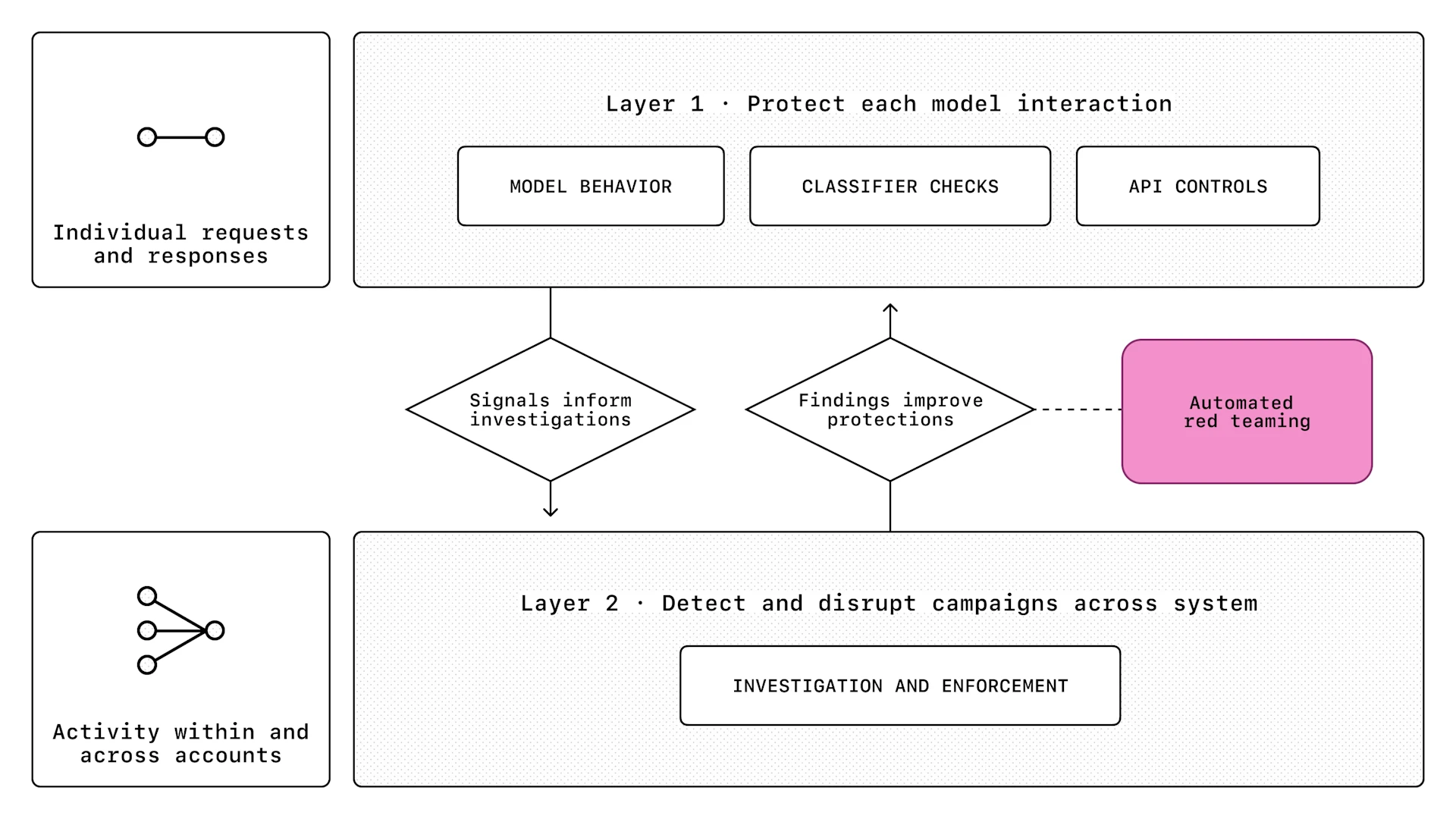
OpenAI describes defenses at two complementary levels. At the request level, model behavior, classifier checks, and API controls limit reasoning trace extraction. At the campaign level, the company looks for patterns in request level and account level signals that can reveal coordinated extraction attempts. Adversarial training teaches models to recognize extraction attempts and refuse to disclose protected reasoning, while preserving legitimate explanations. The training examples come from successful attacks found through internal red teaming, investigations, and responsible disclosures from outside researchers.
OpenAI also uses input classifiers to detect extraction attempts, and output classifiers to detect leaks in assistant messages and tool call arguments. These safeguards apply to streaming and non streaming responses. Tool call coverage is one of the most practical changes. A model can expose protected reasoning in a tool argument without including it in its final answer. OpenAI says output classifiers can block suspected leaks before that content reaches the caller.
Why conversation history controls matter in OpenAI GPT-6.2 Astra reasoning extraction defenses
People often treat conversation history as a convenience feature. It lets a model remember what was said and build on earlier work. In reasoning extraction, history is also a risk surface. If reasoning can be carried from one conversation to another, or from one user to another, then a single leak can be reused many times. OpenAI says its September disclosure described attacks that moved encrypted reasoning from one conversation into another and asked the model to reveal it in user readable form.
The company says it strengthened protections across user, workspace, organization, and model family boundaries, including closing a pathway that could expose another user encrypted reasoning. With GPT-6.2 Astra and GPT-6.2 Sol, OpenAI ties protected reasoning to the conversation history that produced it. As new messages are added, the model can build on earlier reasoning. If a user rewrites an earlier message, the API drops the reasoning that followed it. That reduces reuse, and it also means editing history has a cost. OpenAI also prevents older model families with weaker safeguards from reading GPT-6.2 Astra and Sol protected reasoning.
Campaign level enforcement: thousands of accounts every week
OpenAI can block a single request, and a campaign can still succeed by spreading the work across many accounts. OpenAI says that is why it investigates coordinated attempts, not only individual prompts. When its systems detect unauthorized adversarial distillation campaigns, it investigates the accounts responsible. When it identifies violations, it enforces against the network of accounts, consistent with its policies and terms of service.
OpenAI says its weekly enforcement actions against these campaigns have ranged from thousands to tens of thousands of accounts, with the rate increasing significantly during the summer of 2026. The company says it has seen multiple unauthorized campaigns on its platform this year. It also says it tracks the prevalence of distillation abuse, and the time between detection and enforcement. Its stated objective is to constrain the volume and value of the data distillers can obtain, to increase the cost of campaigns, and to shorten response time.
The September campaign that set the context
The November announcement follows OpenAI September 30, 2026 disclosure of a coordinated campaign first observed on 1 July 2026. Unite.AI reports that the earlier disclosure described 16,000 attempted extraction requests from more than 4,000 users on 24 and 25 July 2026. OpenAI identified a wider related cluster of more than 15,000 users, and OpenAI said it disrupted the activity by 28 July 2026. OpenAI attributed a core cluster of that activity to individuals associated with Moonshot AI, the developer of Kimi, while noting that it was unclear whether all operators belonged to one actor.
Report that attribution as OpenAI attribution, not as a proven fact. The sources checked did not include an independent adjudication, and they did not include a public response from Moonshot AI that settled the claim. The technique is clearer. Operators copied encrypted reasoning from one conversation and asked a model in another conversation to decrypt and transcribe it. OpenAI said that method did not break encryption in the usual sense, and did not involve a database breach. It manipulated model interactions so protected reasoning could be reproduced in requester visible form at scale.
The national security angle, and the legislation OpenAI supports
OpenAI places adversarial distillation in a national security frame. It says a foreign actor that reproduces advanced capabilities from a United States model can deploy them without the protections its developer put in place. In February, it briefed Congress on activity indicating that DeepSeek was attempting to distill United States frontier models. In September, it reported disrupting a campaign to extract its models protected reasoning and attributed a core part of that activity to individuals associated with Moonshot AI.
It says it plans to share more soon about recent campaigns it has disrupted. The company says it supports legislation that would give the United States government more tools to identify and sanction foreign actors that illicitly extract capabilities from American AI models. It says it has told Congress it supports the Chip Security Act, the AI OVERWATCH Act, and the MATCH Act.
What this means for developers and product teams
The most immediate impact is for teams that build on the OpenAI API, especially teams that use tool calling, long conversations, or multi user workflows. First, treat tool call arguments as a place where sensitive content can appear. A review that checks only the final answer is not enough. Check the arguments passed to tools, the data returned by tools, and any logs that store those arguments. OpenAI says its output classifiers now inspect tool call arguments in streaming and non streaming responses, and can block suspected leaks before they reach the caller.
Second, design history with the new tie in mind. In GPT-6.2 Astra and GPT-6.2 Sol, rewriting an earlier message drops the reasoning that followed it. Test a feature that edits history after the edit. Third, do not build a product that depends on reusing protected reasoning across conversations, users, workspaces, organizations, or model families. OpenAI says it restricts that reuse. Fourth, test explanation flows, because stricter behavior may affect legitimate requests.
The limits of the numbers, stated plainly
A strong headline can hide important limits, so this section states them directly. The 54.0 percent to 0.2 percent result is from an internal adaptive black box evaluation. It aggregates results across six attacker models. It does not publish the number of test prompts, the diversity of those prompts, the query budget given to each attacker, or the false positive rate for legitimate requests. Without those details, a reader cannot judge how the test would behave on a different prompt set, or how often legitimate explanations are blocked.
The result also measures successful extraction attempts, not the resulting student model capability. OpenAI does not provide a quantitative measure of how much the defenses reduce downstream training gains in this post, except through the separate cyber study. The 0.2 percent figure is not zero. In a large scale campaign, a small success rate can still produce useful data if the attacker makes enough attempts. That is why campaign enforcement matters. Finally, the sources for this post are narrow, and the sources checked included no independent replication.
What to watch next for OpenAI GPT-6.2 Astra reasoning extraction defenses
OpenAI says it plans to share more soon about recent campaigns it has disrupted. A future disclosure could add detail on scale, methods, and enforcement. Another step to watch is the rollout of selected safeguard improvements to GPT-6 Astra. OpenAI says it is now applying those improvements. A third step is independent testing. If another lab or research group publishes an evaluation with a shared method, the OpenAI numbers can be compared against it.
The headline is strong. The average success rate for extracting reasoning from an earlier request fell from 54.0 percent to 0.2 percent, and the rate for the current request fell from 22.9 percent to 0.9 percent. The change that matters most in the OpenAI GPT-6.2 Astra reasoning extraction defenses is not the percentage alone. It is the shift in where the boundary sits. The boundary now extends beyond the final answer to tool call arguments, to conversation history, and to reuse across users, workspaces, organizations, and model families. A product that only checks the visible answer is no longer checking the full surface.