
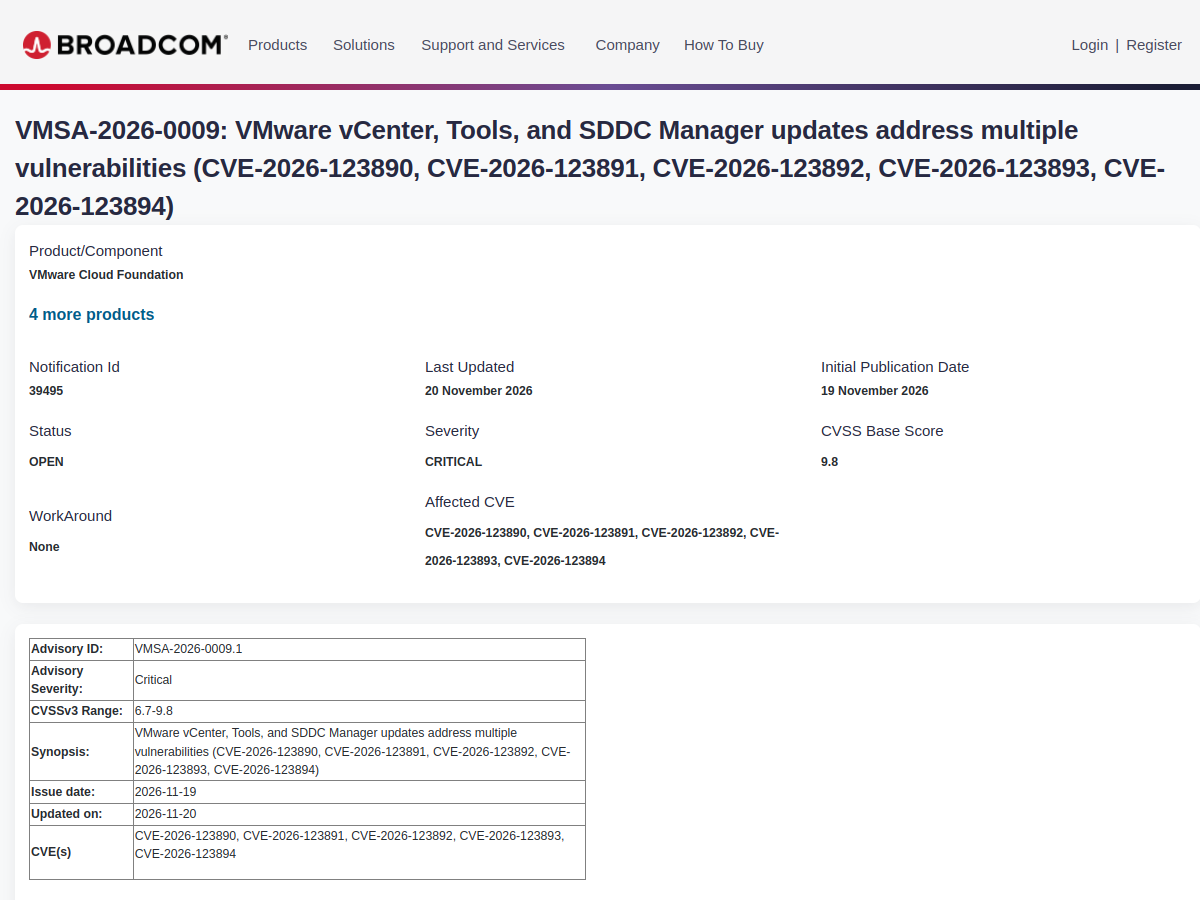
Broadcom issued the VMware vCenter CVE-2026-123890 patch on 19 November 2026, after the flaw had already been used in real attacks. The flaw lets an attacker with network access to vCenter bypass authentication and gain administrative access, with no password needed at the start. Broadcom calls the update an emergency change. Plan it, test it if you can, and install it as soon as your change process allows.
The flaw carries the ID CVE-2026-123890. Broadcom rates it 9.8 out of 10 under CVSS version 3.1. There is no workaround. If you run an affected version, the fix is the patch. Network controls can reduce exposure, but they do not fix the flaw itself.
Attribution needs care. Broadcom did not confirm exploitation in its advisory. Mandiant and Google Threat Intelligence Group, known as GTIG, did. In a report on 19 November 2026, they said a suspected China nexus espionage actor tracked as Armory Castle, formerly tracked as UNC5221, exploited the flaw in early September 2026, more than two months before the patch. Mandiant reported the flaw to Broadcom. Treat the state sponsored link as an assessment by Mandiant and GTIG, not as a statement by Broadcom.
On 20 November 2026, CISA added CVE-2026-123890 to its Known Exploited Vulnerabilities catalog, known as KEV. The entry gives United States federal civilian agencies until 23 November 2026 to remediate, and it requires forensic triage. That deadline applies to those federal agencies. For everyone else, it is still a useful signal, because CISA adds a flaw to KEV only when it has evidence of active exploitation.
Why vCenter control matters
VMware vCenter Server is the central management platform for VMware virtual infrastructure. It configures, controls, and monitors ESXi hosts and the virtual machines that run on them. If an attacker controls vCenter, the attacker can use the management plane to reach hosts, create accounts, and pull data from systems that trust vCenter. A flaw in a single application may expose one service. A vCenter bypass can expose the whole virtual estate. It should never be reachable from the internet in normal operation.
How the flaw works
Broadcom says VMware vCenter contains an authentication bypass vulnerability in the VMware Directory Service. That service, often called vmdir, is part of the identity system behind vCenter Single Sign On. A bypass there does not attack a password. It goes around the check that asks for a password.
Mandiant and GTIG describe CVE-2026-123890 as an unauthenticated Secure Remote Password session key disclosure vulnerability over DCE/RPC. The vulnerable service is vmdird, on TCP port 2012. Exploitation created a session as administrator@vsphere.local. The root cause was predictable UUIDv1 timestamp generation, which exposed the shared session key. With that key, the attacker could create an administrator session, run commands, and take the directory database file known as data.mdb. The attack tool could also extract the SAML signing key, which can be used to forge tokens and impersonate users.
The timeline
In early September 2026, Armory Castle exploited the flaw against a vCenter server inside a network the group had already entered, according to Mandiant and GTIG. That server already had the July patch for an earlier flaw, CVE-2026-59309. On 15 October 2026, Mandiant and GTIG described exploitation of a zero day in BeyondTrust Remote Support, tracked as CVE-2026-102764, with a CVSS score of 9.3. That flaw was the entry point in the campaign that later reached vCenter. On 19 November 2026, Broadcom published VMSA-2026-0009, and Mandiant and GTIG published their follow up report. On 20 November 2026, CISA added the flaw to KEV.
How Armory Castle reached vCenter
Mandiant and GTIG describe a chained campaign, not a single exploit fired from the internet. It started with BeyondTrust Remote Support. Armory Castle exploited CVE-2026-102764 to gain initial access. From the compromised Remote Support appliance, the group moved to an internal Linux appliance that lacked endpoint detection and response tooling, known as EDR.
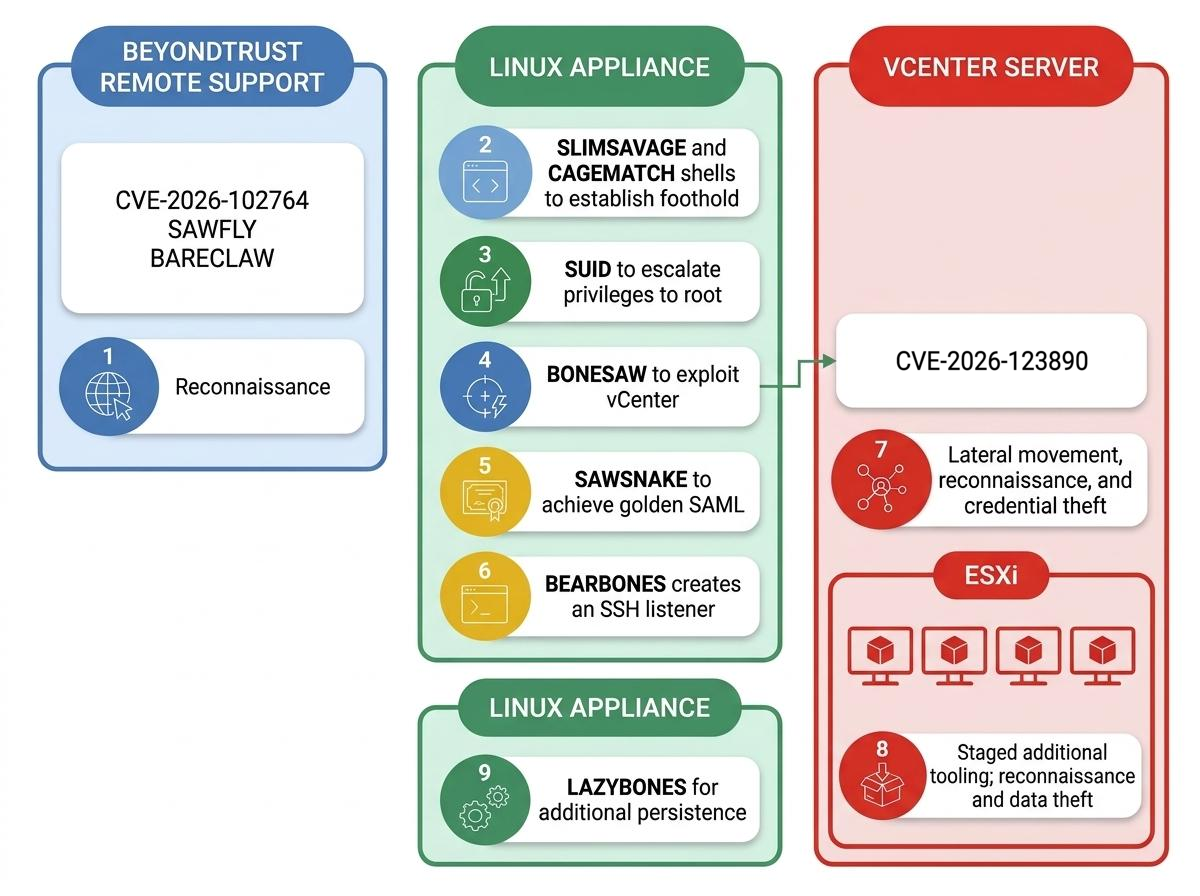
On that appliance, the group deployed webshells and backdoors, including SLIMSAVAGE, CAGEMATCH, BEARBONES, and LAZYBONES. It scanned the internal network for VMware systems on ports 9080, 5480, and 2012. Port 2012 is the control interface for vCenter Single Sign On.
The group then used a custom Golang utility named BONESAW. It uses CVE-2026-123890 to exfiltrate the directory database, hijack the SAML Security Token Service, and create a Single Sign On administrator account. BONESAW achieves full system compromise against vCenter Server 7.x and 8.x appliances, according to the researchers. It can extract the SAML private signing key, forge administrative SAML tokens, and assign Global Administrator rights.
Shortly after BONESAW ran, the group deployed SAWSNAKE, a second Golang utility. It supports Golden SAML attacks, which use a stolen signing key to forge tokens, bypass multifactor authentication, and impersonate any user. The recovered BONESAW binary has a Go build timestamp of 13 July 2026, 16 days before Broadcom disclosed CVE-2026-59309. The researchers caution that someone can modify Go build metadata, so that date alone does not prove when the flaw was discovered.
A second directory flaw in the same year
CVE-2026-123890 is not the first critical authentication bypass in the VMware Directory Service in 2026. On 29 July 2026, Broadcom published VMSA-2026-0006, which addressed CVE-2026-59309 and CVE-2026-59310. CVE-2026-59309 was also an authentication bypass in the VMware Directory Service, also rated 9.8. CVE-2026-59310 was a directory traversal flaw in the vCenter syslog server, also rated 9.8. The two directory flaws are related but distinct. CVE-2026-59309 used crafted LDAP packets on TCP ports 389 or 636. CVE-2026-123890 uses the vmdir DCE/RPC interface. Broadcom says the new flaw is a new and distinct issue, and that systems patched in July still need the new update.
The other four flaws
VMSA-2026-0009 fixes five flaws in total. CVE-2026-123891 is an SQL injection vulnerability in SDDC Manager, rated 8.1. CVE-2026-123892 is an authenticated command injection vulnerability in SDDC Manager, rated 7.2. CVE-2026-123893 is a local privilege escalation vulnerability in SDDC Manager, rated 6.7. CVE-2026-123894 is a SAML token signature bypass vulnerability in VMware Tools for Windows, rated 6.7. The overall CVSS range is 6.7 to 9.8, and all five flaws list no workaround.
Which versions are fixed by the VMware vCenter CVE-2026-123890 patch
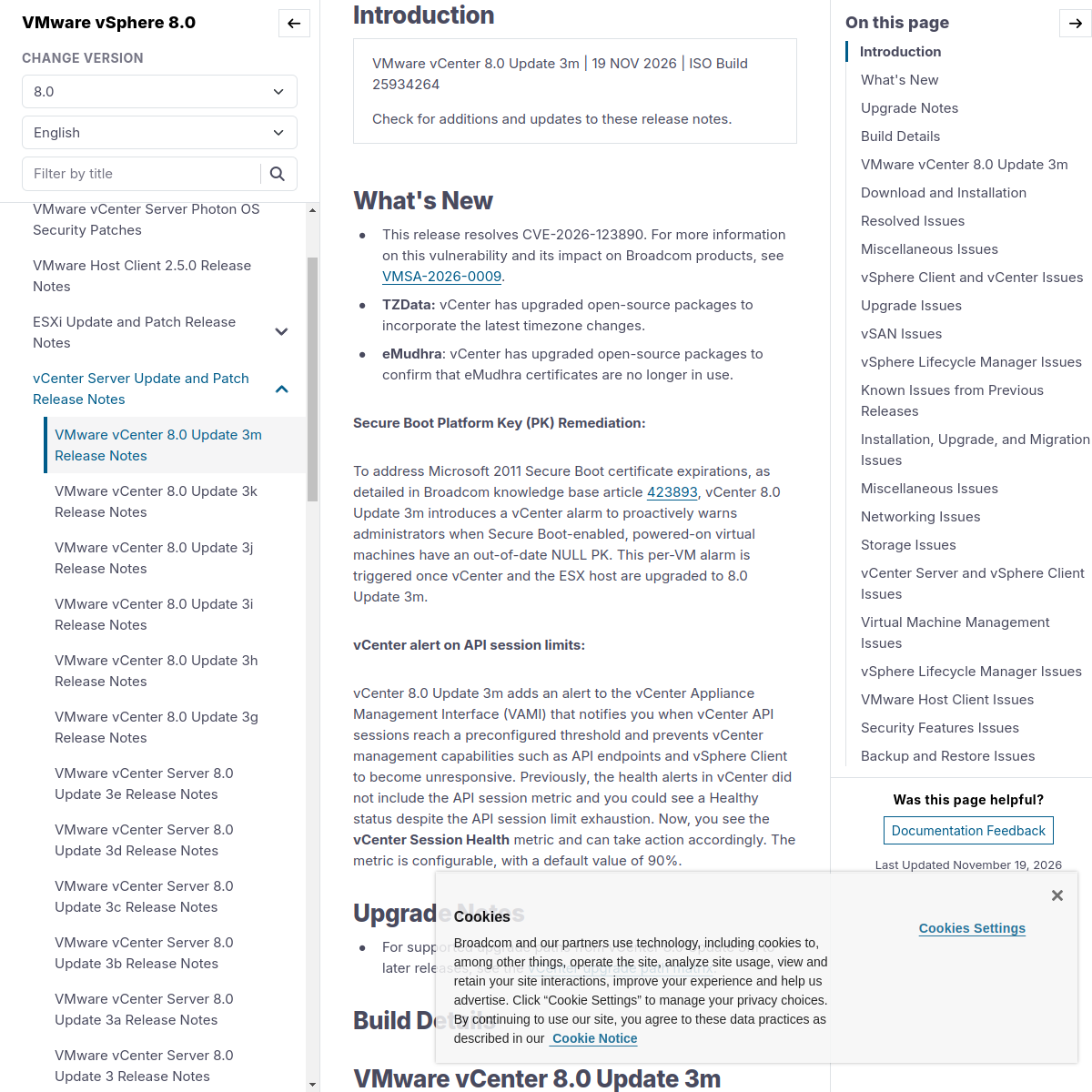
Use the advisory as the source of truth, because build numbers differ by branch. In VMware Cloud Foundation and VMware vSphere Foundation, version 9.1.x gets the fix in 9.1.1.0200, and version 9.0.x gets the fix in 9.0.2.0200. Standalone VMware vCenter Server 8.0 gets the VMware vCenter CVE-2026-123890 patch in 8.0 U3m, with ISO build 25934264. VMware Cloud Foundation 5.x gets the fix in version 5.2.5, applied through asynchronous patching in Broadcom knowledge base article KB88287. For VMware Telco Cloud Platform and Telco Cloud Infrastructure, Broadcom points to knowledge base article KB463116, with vCenter 8.0 U3m as the fixed build.
For SDDC Manager, the fixed versions are 9.1.1.0200, 9.0.2.0100, and 5.2.5, by branch. For VMware Tools for Windows, the fixed versions are 13.1.5.0 for the 13.x branch and 12.5.5 for the 12.3.x, 12.4.x, and 12.5.x branches. Patches in this advisory are cumulative.
Two notes can catch teams out. First, the vCenter updates cannot be installed through vCenter Quick Patch. Second, installing vCenter 8.0 U3m or 9.0.2.0200 blocks a later upgrade to VMware Cloud Foundation 9.1.1. The options described in the coverage are to upgrade vCenter to 9.1.1 first and apply the security update there, or to wait briefly for VCF 9.1.2.
The vCenter 7 problem
vCenter 7.0 is a special case. Broadcom lists vCenter 7.0 as affected, with a CVSS score of 9.8, but it does not list a public fixed version. The advisory says to contact Broadcom Support if you have an extended support contract. That is because vCenter 7.0 left general support on 2 October 2025. Broadcom says to presume vSphere 6.5 and 6.7 affected. Mandiant and GTIG say BONESAW achieves full system compromise against vCenter Server 7.x and 8.x appliances. If you have an extended support contract, contact Broadcom Support immediately. If you do not, treat migration to a supported version as an urgent project, restrict network access to vCenter as tightly as possible, and monitor it closely. None of those steps fixes the flaw.
Patching is not enough after the vCenter patch if you were breached
Patching CVE-2026-123890 closes the flaw. It does not undo what an attacker already did, and it does not invalidate a stolen signing key on its own. If an attacker created an SSO administrator account, exfiltrated the directory database, or extracted the SAML signing key, those changes can persist after the patch. That is why Mandiant and GTIG urge organizations to both apply the patches and examine their systems for evidence of compromise. CISA requires forensic triage for federal agencies in its KEV entry.
Check for new SSO administrator accounts, especially accounts created in early September 2026 or later. Review logs for sessions as administrator@vsphere.local that do not match normal work, and for access to port 2012 from unexpected systems. Look for exfiltration of the data.mdb file. Consider rotating the Security Token Service signing certificate and all SSO passwords if compromise is suspected. If you find evidence of compromise, treat it as an incident, preserve logs, and involve your incident response team or provider. If you find no evidence, check logs for the full period from early September 2026 onward.
What to do now: apply the vCenter patch
First, inventory every vCenter instance, including standalone vCenter, vCenter in Cloud Foundation and vSphere Foundation, vCenter in Telco Cloud products, and any test, lab, or disaster recovery instance that is still powered on. Include vCenter 7.0 instances, and include SDDC Manager and VMware Tools versions.
Second, confirm each version against the fixed versions in VMSA-2026-0009. Third, reduce exposure while you patch. Restrict network access to vCenter management interfaces to only the systems and administrators that need it. Block access from the internet if it is present. Review firewall rules for ports 443, 5480, 9080, and 2012.
Fourth, patch in priority order, starting with internet reachable vCenter, then production vCenter, then lab instances. Do not leave a lab instance unpatched. Also, remember that Quick Patch cannot deliver these updates. Fifth, verify the patch by checking the version and build number, and test sign in and normal tasks. Sixth, run the compromise review above in parallel with patching, and preserve logs before you patch if you can. Seventh, rotate credentials and keys if there is any doubt, including the Security Token Service signing certificate if key theft is suspected. Eighth, harden vCenter for the next flaw, with logging, EDR on Linux appliances that can reach vCenter, and monitoring for new SSO administrator accounts and for access to port 2012 from unexpected sources.
For smaller teams, however, the work is the same, at a smaller scale. If you use a managed service provider, ask in writing which vCenter versions you run, when each instance will be patched and to which exact fixed version, and what compromise review the provider will run.
The bottom line: apply the vCenter patch
In short, Broadcom issued an emergency patch on 19 November 2026 because the flaw is severe, it has no workaround, and it was already being exploited. CVE-2026-123890 lets an unauthenticated attacker with network access bypass authentication in the VMware Directory Service and gain administrative access to vCenter. Mandiant and Google Threat Intelligence Group attribute the exploitation to Armory Castle, a suspected China nexus espionage actor formerly tracked as UNC5221, which used the flaw in early September 2026 as part of a campaign that started with a BeyondTrust zero day. CISA added the flaw to KEV on 20 November 2026, with a federal due date of 23 November 2026.
Therefore, patch to 9.1.1.0200, 9.0.2.0200, or 8.0 U3m, depending on your branch, and apply the matching fixes for SDDC Manager and VMware Tools. If you are on vCenter 7.0, contact Broadcom Support under extended support and plan migration. Do not rely on the July patch for CVE-2026-59309. Patching is the first step, not the last step. Check for compromise, rotate keys and passwords if there is evidence of key theft, and harden vCenter so the next directory flaw is harder to reach.