
Flipper One raised $11.7 million in its first day on Kickstarter, and that number tells only part of the story. The real question is whether a pocket Linux computer built for networks and radio work can live up to that level of demand.
The campaign opened on 17 November 2026. Flipper Devices set a funding goal of $300,000. Backers passed that goal in four minutes. The total reached $1 million in 15 minutes and $2 million in 30 minutes. By the end of the first 24 hours, the total was more than $11.74 million, according to Notebookcheck. That is 39 times the original goal, which rounds to roughly 40 times in headline terms.
This post was prepared on 21 November 2026, four days after launch. By then the total had already moved higher. TechSpot reported a live total of more than $13.7 million on its updated campaign page. RTL SDR reported more than $12 million from over 23,000 backers on 19 November. The exact total changes as new pledges arrive, so treat any live figure as a snapshot, not a final result. The first day figure is the fixed fact that matters most. It shows demand, not delivery.
For comparison, Flipper Zero raised $4,882,784 from 37,987 backers when it closed on Kickstarter on 29 August 2020, according to Osegi. It reached its goal in eight minutes. Flipper One passed the entire Flipper Zero Kickstarter total in less than a day. That comparison is useful, but it also sets a trap. A bigger first day does not mean a finished product. It means more people are waiting for one. The campaign runs until 17 December 2026, and backers should read it as a pre order for a device still in development, not as a retail order.
What Flipper One Actually Is
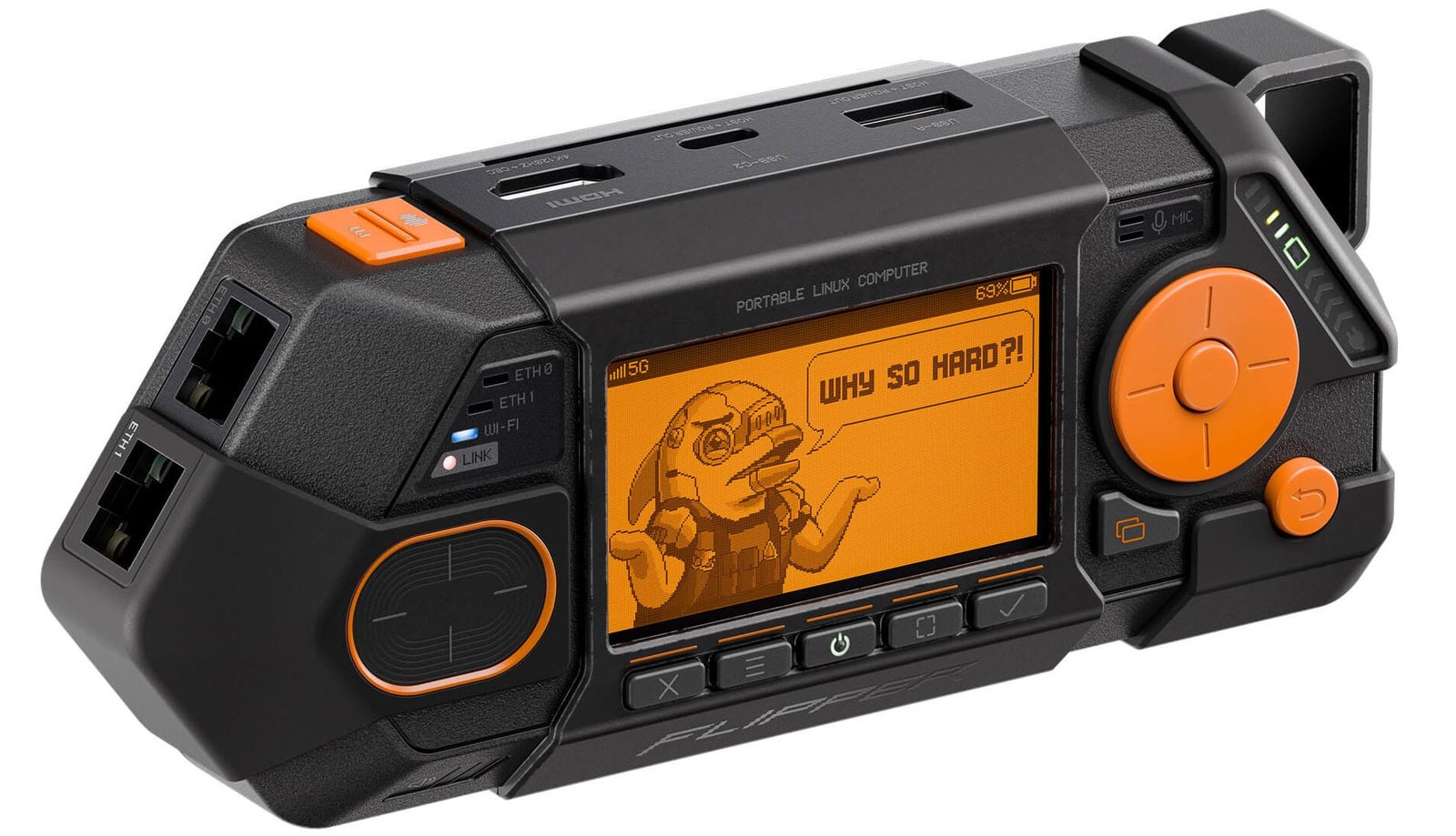
Flipper One is a portable, standalone Linux computer built around networking. It is not a phone, it is not a laptop, and it is not a game handheld. It is a small rugged device with its own screen, buttons, touchpad, ports, and battery. You can use it on its own, or you can plug it into a monitor and use it as a desktop.
Flipper Devices describes it as a layer one tool. In plain terms, it works with IP connected systems. That means WiFi, Ethernet, cellular data, and satellite links. It is built to route traffic, scan networks, analyse packets, run VPN tunnels, and run Linux apps in the field. It can also run software defined radio apps and local AI models, where the hardware and software allow it. The device was first announced in May 2026, and Flipper opened a public Developer Portal at the same time, with documentation and discussion of unfinished work.
Why It Is Not Flipper Zero 2
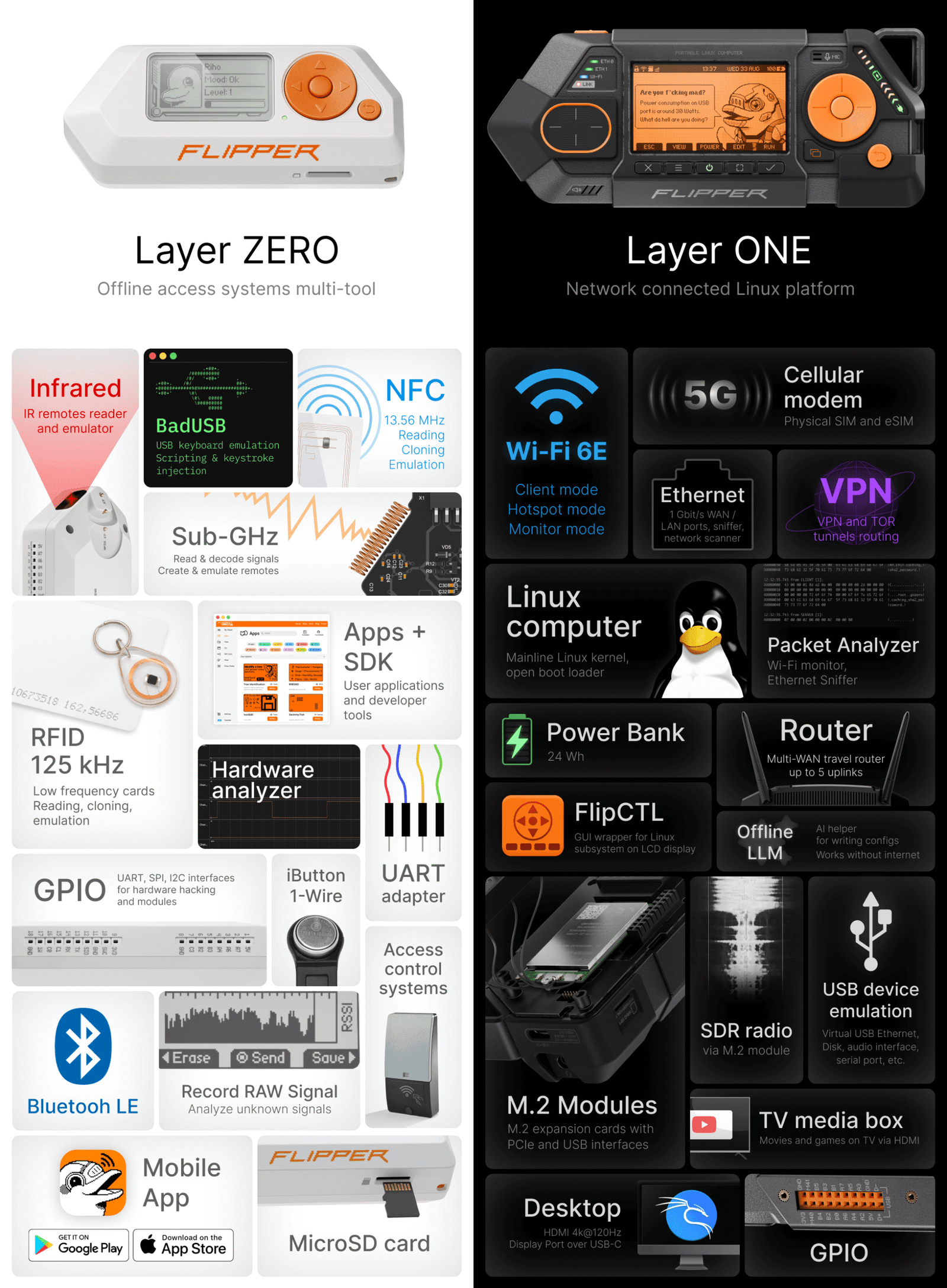
The most common mistake in early coverage is to call Flipper One a Flipper Zero 2. Flipper Devices is clear on this point. It is not a successor. It is a different device for a different job. Flipper Zero works at what the company calls layer zero. It is a low power microcontroller device for offline point to point protocols, including NFC, RFID, sub GHz radio, infrared, and wired protocols such as UART, SPI, and I2C.
Flipper One works at layer one. It works with IP networks and Linux computing. It has no NFC, no RFID, and no sub GHz radio built in. If you want those protocols, Flipper Zero remains the tool for that work. If you want to test a network, route traffic between several links, or run Linux tools without a laptop, Flipper One is the tool built for that work. Flipper Zero costs $169 on the Flipper website, and the company says it has sold over one million units since 2020. That track record helps explain the trust behind the launch. It does not guarantee that Flipper One will ship on time.
Inside the Hardware
Flipper One uses two processors. The main processor is a Rockchip RK3576, an eight core Arm chip with four Cortex A72 cores at 2.2 GHz and four Cortex A53 cores at 1.8 GHz. It also includes a Mali G52 MC3 graphics processor and a neural processing unit rated at 6 TOPS. The main chip runs Linux, apps, networking, USB, and video output.
The second processor is a Raspberry Pi RP2350 microcontroller. It controls the display, buttons, touchpad, LEDs, power, and boot, and it runs its own firmware, separate from Linux. If Linux crashes, or if you break the main system while testing, the screen and controls can still work. You can manage boot, power, and recovery without another computer.
Memory and storage are 8 GB of LPDDR5 RAM and 64 GB of UFS 2.2 storage, plus a microSD card slot. Flipper Devices says RAM and UFS storage now account for more than half of the hardware cost, a claim tied to the current memory shortage driven by AI demand. The display is a small 256 by 144 grayscale LCD behind Gorilla Glass. Battery capacity is listed as 24 Wh, but CNX Software notes that mass production battery capacity is not final. The device measures 155 by 67 by 40 mm. Weight is listed as to be decided.
Networking First
The ports tell you what Flipper One is for. It has two Gigabit Ethernet ports, WiFi 6E across 2.4 GHz, 5 GHz, and 6 GHz, using a MediaTek MT7921AUN chip, with monitor mode, Bluetooth 5.2, USB Ethernet up to 5 Gbps over USB C, full size HDMI 2.1 up to 4K at 120 Hz, USB C DisplayPort Alt Mode up to 4K at 120 Hz, USB A and USB C host ports, a 3.5 mm audio jack, a Nano SIM slot, a built in eSIM, a 20 pin GPIO header, and an internal M.2 Key B slot.
Flipper says the device can manage up to five simultaneous uplinks, with failover and load balancing. It can act as a router, a hotspot, a VPN gateway, a firewall, and a bridge between wired and wireless networks. It also includes a network scanner and tools for traffic tunnelling and packet analysis. These are powerful tools for authorised testing, lab work, and learning. They are not a licence to test a network you do not own or do not have written permission to test.
Radio Modules: SDR, LoRa, and 5G
Radio work is the second half of the story, and it is where buyers need the most care. Three official modules are offered through Kickstarter. The LoRa module costs $59 as an add on. It works with Meshtastic, MeshCore, and Reticulum mesh networks, and it can work as a walkie talkie between devices. LoRa is useful for off grid messaging and mesh experiments where cellular coverage is poor.
The SDR module costs $149 as an add on. SDR stands for software defined radio. It lets a computer receive and process radio signals in software. The preliminary figures are a frequency range of 24 to 1700 MHz with 10 MHz of bandwidth. Flipper notes that the SDR specifications are not final yet. Do not back the SDR bundle on the basis of a final spec sheet that does not exist yet.
The 5G module costs $219 as an add on. It is based on a Quectel RM520 modem, with download speeds up to 1 Gbps and four antennas, according to CNX Software. It replaces the back cover and adds SMA ports for external antennas. The built in eSIM comes pre provisioned with a Flipper SIM data plan, but it only becomes useful once the 5G module is installed. Bundle prices are $439 with LoRa, $539 with SDR, $599 with 5G, and $759 for the Ultimate Bundle with all three modules.
Flipper OS and Open Linux
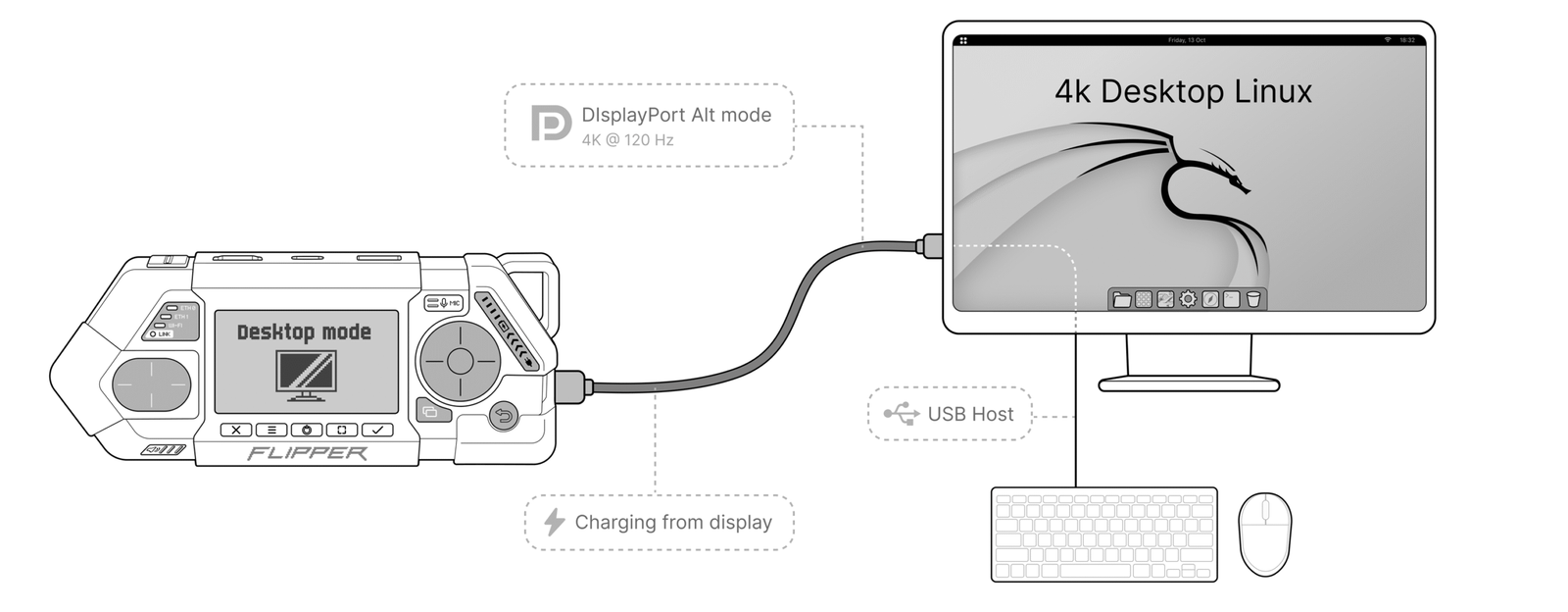
Flipper One runs Flipper OS, a Debian based Linux system. The key idea is profiles. A profile is a full snapshot of the system, with its own packages, settings, kernel, and apps. You can boot a profile, clone it, break it, and jump back to a clean copy, or switch to a different profile for a different job. The profiles named in reports include router, radio lab, desktop, and TV media box. FlipCTL is the interface layer for the small screen. It wraps tools such as ping, nmap, and traceroute in a menu that fits a 256 by 144 screen. Desktop mode works over USB C, and a TV mode works over HDMI.
Flipper Devices wants Flipper One to be the most open and best documented Arm computer it can build. The company has partnered with Collabora to push full support for the Rockchip RK3576 into the mainline Linux kernel. The official blog says one binary blob remains in the boot chain, the DDR trainer that initialises RAM during early boot, and drivers for the NPU and hardware video decoding are not fully upstream yet. CNX Software notes that binary blobs will still be needed for wireless and cellular connectivity for regulatory reasons. The direction is open. The finished state is not yet fully open.
Price, Shipping, and the Memory Problem
The public Kickstarter price is $399 for the Flipper One Kickstarter Special. The estimated retail price is $550, a 25 percent discount on paper. The box includes the Flipper One and a USB C cable, according to Its FOSS. An earlier $379 tier was available to people who bought a $20 refundable pre order coupon. That tier has sold out. The $399 tier is capped at 15,000 units, according to Lonely Guy Gadgets.
Flipper says the $399 price leaves it with no profit margin. RAM and UFS storage now account for more than half of the hardware cost. XDA Developers reports that co founder and CEO Pavel Zhovner said the company would need to sell Flipper One for around $500 to make production financially sustainable. CNX Software notes that RAM capacity could be reduced if prices do not come down. The campaign is all or nothing on Kickstarter, so backers are only charged if the campaign succeeds.
Shipping is expected to begin in July 2027 in most markets, about eight months after launch. Shipping is not included in the $399 price. The shipping countries listed in reports are the United States, Canada, the United Kingdom, Australia, all 27 European Union countries, Switzerland, Norway, Singapore, and Hong Kong. If you live outside that list, do not back the campaign expecting delivery. The design is on its third hardware revision, with about 90 percent of technical specifications finalised, and it is still in early engineering validation. Component shortages could delay delivery.
Who Should Back It, and Who Should Wait
Flipper One makes sense for security researchers and network engineers who need a portable Linux tool for authorised testing, for radio enthusiasts who want SDR and LoRa in a pocket Linux device, and for Linux developers who want an open Arm computer with a public Developer Portal. It does not make sense for anyone who needs a device soon, for anyone who wants a Flipper Zero replacement, or for anyone who wants a general purpose laptop or a media player only. A laptop will be faster and more flexible, and a cheap media box will be simpler.
If you back Flipper One, back it for what it is today, a $399 pre order for a third revision prototype with a strong network focus, not for what it might become in a year. Check your country is on the shipping list, add only the modules you will use, and read the campaign risks section on Kickstarter before you pledge. If you wait, you lose the $399 launch price, but you gain certainty on final specs and the real shipping date. The next test is harder than the first day. It is to turn $11.7 million of demand into a device that ships, works, and stays open.