
Nvidia Vera Rubin shipping is now a fact, not a roadmap date. NVIDIA reported record revenue on 17 Nov 2026, and in the same release it said Vera Rubin NVL72 has shipped. That moves the next generation of AI chips from announcement to installed hardware. Cloud buyers can now ask for delivery dates, not launch dates.
NVIDIA now has to prove that the ramp can grow without breaking its margins, its power budgets, or its supply chain.
This post explains what NVIDIA reported, what Vera Rubin NVL72 is, where the racks are running, why the margin is forecast to fall, what ASUS adds, and what to watch next.
Numbers below come from the NVIDIA release of 17 Nov 2026, the official NVIDIA product page, or the ASUS release of 18 Nov 2026, unless another source is named.
Nvidia Vera Rubin shipping in numbers
NVIDIA reported revenue of 115.8 billion dollars for the third quarter of fiscal 2027, the quarter ended 25 Oct 2026. Revenue rose 20 percent from the previous quarter and 103 percent from a year earlier. It beat the guidance NVIDIA gave on 26 Aug 2026, which was 108.0 billion dollars, plus or minus 2 percent.
Data Center revenue was 107.6 billion dollars, up 21 percent from the previous quarter and 110 percent from a year earlier. Data Center is now about 93 percent of total revenue.
Profit stayed very high. GAAP gross margin was 74.8 percent. Net income was 65.3 billion dollars on a GAAP basis. GAAP diluted earnings per share were 2.70 dollars.
The outlook is larger still. For the fourth quarter of fiscal 2027, NVIDIA expects revenue of 130.0 billion dollars, plus or minus 3 percent. That quarter includes an extra week. GAAP and non GAAP gross margins are expected to be between 71.0 percent and 72.0 percent. NVIDIA said it is not assuming any Data Center compute revenue from China in that outlook.
The quarter just reported had a gross margin near 75 percent. The next quarter is forecast at 71 to 72 percent. That fall is the cost of ramping a new platform at volume.
What Vera Rubin NVL72 is
Vera Rubin is the platform that follows Blackwell. It is not one chip. It is a rack scale system that combines new Rubin GPUs with new Vera CPUs, plus networking and data processing hardware, so the whole rack works as one large AI computer.
The official NVIDIA product page lists the NVL72 configuration as 72 Rubin GPUs and 36 Vera CPUs. One Rubin GPU carries 288 GB of HBM4 memory, with bandwidth of 19.2 TB per second. At rack scale, total GPU memory is 20.7 TB of HBM4, with bandwidth of 1,400 TB per second. NVLink is sixth generation, with 3 TB per second per GPU and 216 TB per second across the rack.
Performance is listed on the same official page as 3,600 PFLOPS for NVFP4 inference and 2,520 PFLOPS for NVFP4 training at rack scale. One Rubin GPU is listed at 50 PFLOPS for NVFP4 inference and 35 PFLOPS for NVFP4 training. Those are NVIDIA specifications, and the page notes that some values are preliminary and subject to change. Treat them as the vendor specification, not as an independent test result.
The Vera CPU side matters for agentic AI, where a model does many steps and calls tools. The NVL72 lists 3,168 custom NVIDIA Olympus cores, with 6,336 threads, and CPU memory of up to 54 TB of LPDDR5X. NVIDIA also claims one tenth the cost per million tokens compared with GB200 NVL72 for deep reasoning agentic AI, and up to 10 times more tokens per megawatt. Those claims rest on NVIDIA tests with the Kimi K2 Thinking model. Use them as a guide, not as a promise for every workload.
Where Nvidia Vera Rubin shipping has reached
The earnings release said NVIDIA ramped production and began shipping Vera Rubin NVL72, and called it the fastest product ramp in the history of the company. Racks are running at CoreWeave, Google Cloud, Microsoft Azure, Oracle Cloud Infrastructure, and Nebius, and are coming online soon at SpaceXSI. That list is broad and specific. NVIDIA named the partners, so a buyer can ask those providers for Vera Rubin capacity by name.
Reporting of the earnings call put Vera Rubin revenue at close to 20 billion dollars in its first quarter of production shipments. That figure came from call reporting, not from the headline release, so treat it as reported call detail. Even with that caution, the scale is striking. A new platform does not normally reach that level in its first shipping quarter.
NVIDIA also announced general availability of Vera Rubin NVL72 systems and Vera CPUs on Oracle Cloud Infrastructure, and of Google Cloud Vera Rubin powered A5X instances. Oracle and NVIDIA had announced that general availability on 27 Oct 2026. NVIDIA also said it swept every MLPerf Training and Endpoints benchmark. That is a useful check, not a production workload test. Ask for results on the model you actually run.
Why the margin is forecast to fall as Nvidia Vera Rubin shipping ramps
A new rack scale platform costs more to build at first. Yields improve over time. Suppliers learn the new parts. Assembly lines settle. In the first quarters, NVIDIA absorbs more of that cost, and the gross margin falls. That is the normal pattern for a hardware ramp.
The fall from 74.8 percent to a forecast of 71 to 72 percent is about 3 percentage points. On revenue of 130.0 billion dollars, that is a large amount in absolute terms. NVIDIA is still guiding to a very high margin by normal hardware standards. The question is not whether the margin falls in Q4. NVIDIA has already told us it will. The question is whether it recovers as volume rises, and whether the ramp stays on schedule.
There is a second cost to watch. A rack scale system needs liquid cooling, power delivery, and networking. Those costs sit with the cloud provider and the system builder, not only with NVIDIA. Ask for the total cost, including power, cooling, and support, before comparing providers.
What ASUS adds to the story
ASUS announced on 18 Nov 2026 that it is ramping up volume shipments of NVIDIA Vera Rubin NVL72 in Q4 to meet robust market demand. The announcement was made from Chicago, where ASUS was showing its AI Factory reference architecture at SC26, booth 2234, at McCormick Place.
At the center of the ASUS showcase is the ASUS AI POD XA VR721-E3. That system integrates 72 Rubin GPUs and 36 Vera CPUs in a fully liquid cooled, rack scale architecture.
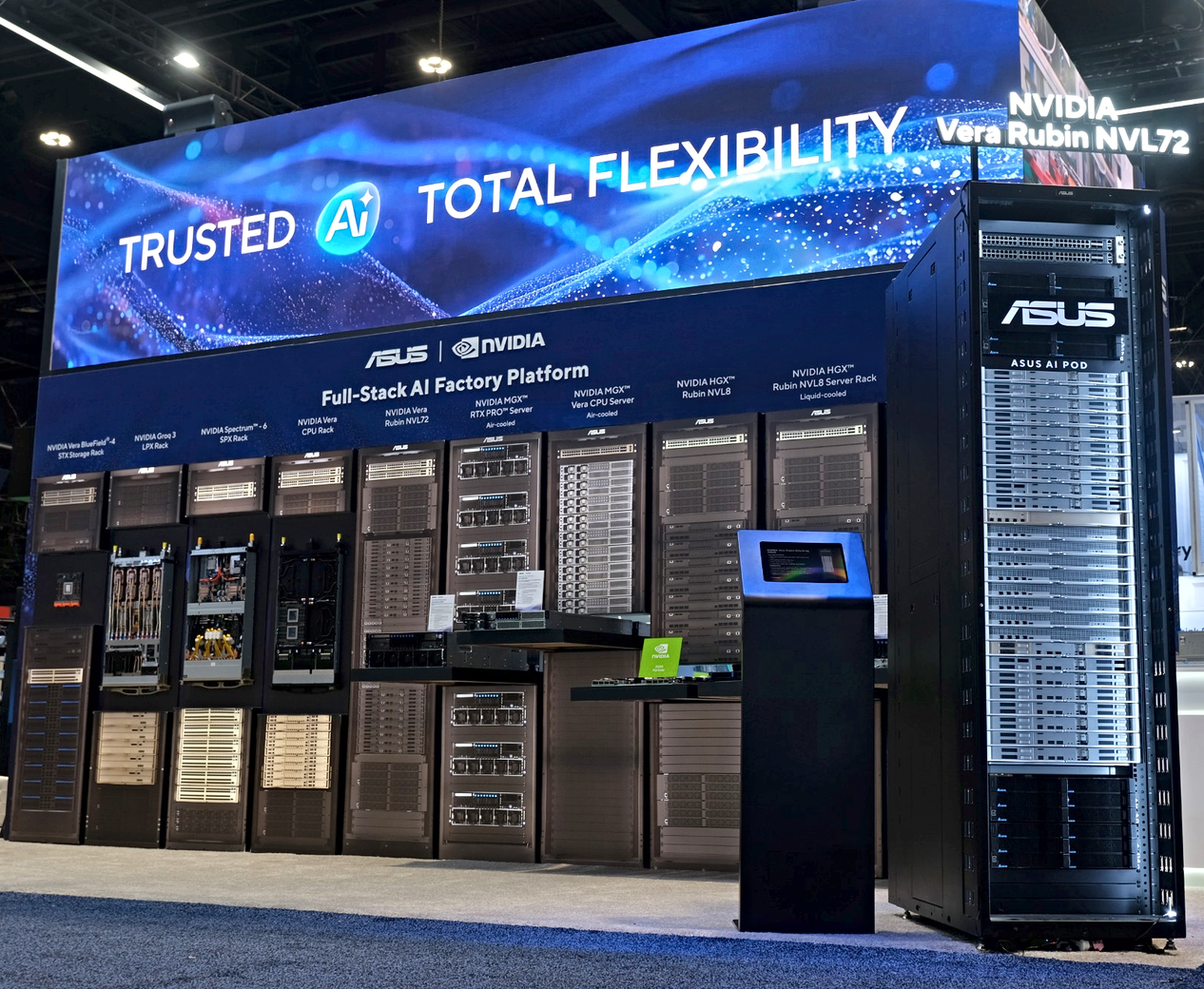
ASUS did not give a shipment count or name its customers in that release. That limits what a reader can conclude. The release does show that more than one builder is now shipping the same NVIDIA platform, and that competition is moving from silicon access to delivery reliability.
ASUS said differentiation now depends on delivery reliability, risk reduction before deployment, and support after delivery, not on silicon access alone. Its pitch rests on automated L10 and L11 manufacturing and a six layer validation framework that covers hardware checks, power cycling, stress testing, NVIDIA diagnostics, and rack level performance. Ask any builder for its validation steps in writing.
The leadership change in the background
This was the first quarterly report since Jensen Huang resigned as chief executive on 12 Nov 2026. Colette Kress, who is also chief financial officer, is interim chief executive. Reporting after the call said Kress raised the fiscal 2028 revenue growth outlook to about 75 percent, from about 70 percent. NVIDIA also said its board approved an increase of 150 billion dollars to the share repurchase authorization in Sept 2026. During the third quarter, NVIDIA returned 28.1 billion dollars to shareholders through repurchases and dividends.
What this means if you buy AI capacity
If you rent AI compute, ask a provider for Vera Rubin capacity by name, for a written delivery date, and for a price per GPU hour that is fixed for the term. If the provider cannot give a date, ask when the next allocation opens.
Do not buy on the headline performance number alone. A rack that lists 3,600 PFLOPS for NVFP4 inference will not deliver that number on every model, at every context length, with every software stack. Ask for a test on your own model, with the same context length and the same batch size you plan to use. Ask for tokens per second, cost per million tokens, and time to first token, not only for peak throughput.
Check the software path too. Ask whether your framework and your inference engine already support Rubin, and what version you need. Check power and cooling before you sign. Ask the provider for power per rack, inlet temperature, and cooling type.
Finally, keep Blackwell in the comparison. Blackwell Ultra is still shipping, and it may be cheaper, easier to get, or better supported for your current workload. Rubin should win on efficiency for large agentic workloads. It does not automatically win for every workload, at every price, on day one. Get both quotes, with the same service terms, and compare total cost, not only list price.
What to watch next in Nvidia Vera Rubin shipping
Watch the fourth quarter report for three things. First, whether revenue reaches the 130.0 billion dollar guidance, plus or minus 3 percent. Second, whether gross margin lands in the forecast range of 71 to 72 percent, or falls below it. Third, whether NVIDIA names more Vera Rubin customers, or gives a clearer volume figure than close to 20 billion dollars in the first quarter.
Watch the cloud providers too. If more providers announce Vera Rubin instances, or if prices per GPU hour fall, that is a sign that supply is easing. If delivery dates slip, demand still exceeds supply. Watch China as well. NVIDIA said its Q4 outlook assumes no Data Center compute revenue from China.
Watch the system builders too. Their delivery times and support terms will decide how fast Vera Rubin moves from a cloud launch to a normal enterprise purchase.
Practical takeaway
Nvidia Vera Rubin shipping is real, it is broad, and it is large. Revenue of 115.8 billion dollars, Data Center revenue of 107.6 billion dollars, and a Q4 guide of 130.0 billion dollars all point in the same direction. The platform is in production, the clouds are running it, and the system builders are ramping with it. If you buy AI capacity, ask for Vera Rubin by name, ask for a written date and a fixed price, test it on your own workload, and compare the total cost with Blackwell before you commit. Shipping is the first test. Sustained delivery at the forecast margin is the next one.
Sources
NVIDIA financial results third quarter fiscal 2027, https://www.globenewswire.com/news-release/2026/11/17/3405200/0/en/nvidia-announces-financial-results-for-third-quarter-fiscal-2027.html. NVIDIA Vera Rubin NVL72 official product page, https://www.nvidia.com/en-gb/data-center/vera-rubin-nvl72/. ASUS press release, https://press.asus.com/news/press-releases/asus-ramps-up-nvidia-vera-rubin-nvl72-shipments-sc26.